
Implement
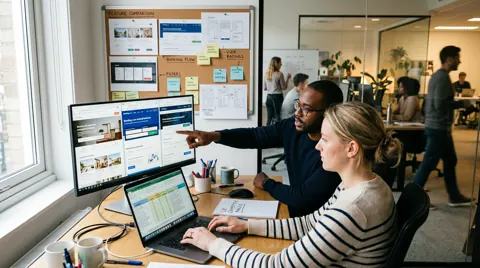
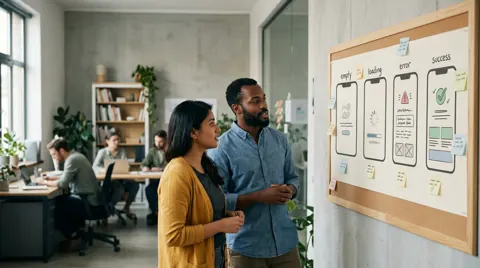
A/B testing
Compare two live variants with real traffic to see which performs better on a chosen metric.

Gumshoe · Working reference
Start with the question you need to answer. Explore 133 methods for understanding people, shaping ideas and improving experiences.
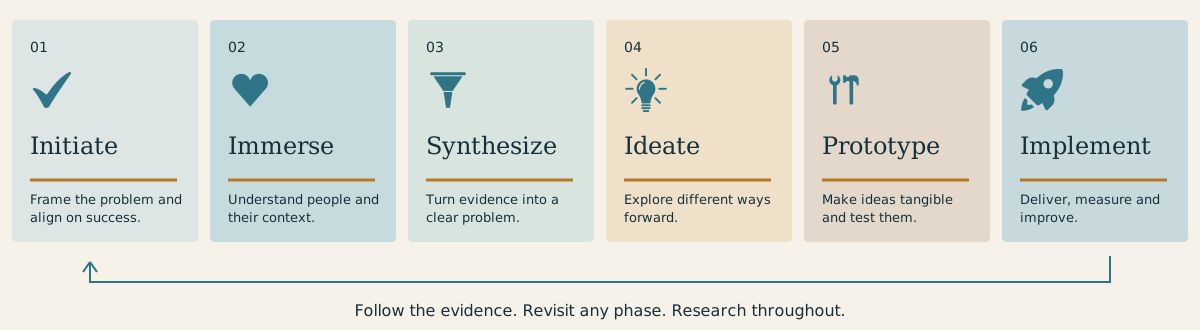
Go to the methods ↓Design thinking is a human-centered, iterative approach to solving problems: understand the people affected, frame the right problem, explore ideas, and test and improve solutions. Evidence guides decisions, and teams revisit earlier phases as they learn.
Follow the evidence
Choose a phase to browse its methods. Revisit any phase as you learn; research belongs throughout.
An iterative practice, not a one-way checklist.
A short CCSQ Centers of Excellence video on human-centered design and balancing stakeholder needs with user needs.
Watch the video → About 4 minutes
Explore the library
Try a broader search or clear the filters.
Implement
Compare two live variants with real traffic to see which performs better on a chosen metric.
Prototype · Implement
Specify accessibility intent, headings, focus order, labels, so it is built in, not bolted on.
Prototype · Implement
Assess whether a product can be used by people with disabilities, against standards and with assistive tech.
Synthesize
Cluster many observations into themes to make sense of qualitative data as a group.
Prototype
Use AI tools to generate working prototypes from prompts in minutes, not days.
Ideate · Prototype
Use AI to draft and vary UX copy fast, then edit with human judgment.
Ideate
Use generative AI as a tireless brainstorming partner to expand and challenge the idea space.
Synthesize
Use AI to accelerate clustering, theme-finding, and summarizing across research data, with a human verifying every claim.
Initiate · Synthesize
Surface the beliefs a plan depends on and sort them by risk so you test the scariest ones first.
Prototype · Implement
Build interfaces from small, composable parts that combine into larger structures.
Ideate · Prototype
Physically act out a scenario to feel the experience and surface real-world constraints.
Ideate
Generate ideas silently in writing, then pass and build, to avoid the pitfalls of verbal brainstorming.
Synthesize · Ideate
Have users group and label content so your structure matches their mental model.
Immerse · Ideate
Design with users and stakeholders as active partners, not just subjects of research.
Prototype
Build a working front-end prototype in code to test real interactions and technical feasibility.
Prototype
Step through a task as a new user would, asking at each step whether they could figure out what to do.
Immerse · Initiate
Compare products or features against each other, including from outside your domain, to learn and set direction.
Immerse · Initiate
Study competing and comparable products to learn conventions, gaps, and opportunities.
Ideate · Prototype
Put an early idea in front of users to gauge value and comprehension before building it.
Prototype · Implement
Check an interface for internal consistency in patterns, terminology, and behavior.
Immerse · Synthesize
Inventory and assess existing content to see what you have, what works, and what must change.
Synthesize · Prototype
Define the structure, types, and relationships of content so it can scale and reuse.
Synthesize · Prototype
Design around real content instead of filling a layout with lorem ipsum.
Immerse
Observe people doing real work in their own environment while they explain what they are doing and why.
Prototype · Implement
Review interface text for clarity, accuracy, voice, and consistency before it ships.
Immerse · Synthesize
Ask people to recount specific memorable moments, good or bad, to surface what truly drives success and failure.
Implement
Collect and analyze unsolicited feedback from the channels users already use.
Immerse · Ideate
Invite a participant to imagine powers that overcome frustrations in an area of their life, then explore the needs behind those powers.
Prototype · Implement
Add notes to designs that explain behavior, logic, and intent for accurate implementation.
Initiate
A one-page contract that aligns everyone on goals, scope, constraints, and success before design starts.
Ideate · Prototype
Gather peers to give structured, goal-focused feedback on work in progress.
Implement
Record design decisions, rationale, and specifications so the knowledge outlives the project.
Prototype · Implement
Give engineering everything it needs to build the design correctly, including the edge cases.
Initiate · Ideate
Pair a proposed design change with the user outcome you expect, so the design itself becomes testable.
Ideate · Prototype
Two people design together in real time, combining perspectives and catching issues early.
Prototype · Implement
Document reusable solutions to recurring design problems so teams solve them once.
Initiate · Synthesize
A short set of shared values that guide decisions and resolve trade-offs consistently.
Implement
Check the built product against the approved design to catch implementation drift before release.
Prototype
Formally review a design against requirements, standards, and stakeholder expectations before it advances.
Ideate · Prototype
Compress understand, sketch, decide, prototype, and test into a focused multi-day sprint.
Ideate
A structured sketch-critique-iterate workshop that gets a cross-functional group designing together.
Prototype · Implement
Build and maintain the shared components, tokens, and guidelines a product is made from.
Ideate
Design the retail box your product would ship in, forcing the team to name its most compelling benefits.
Prototype
Measure the emotional and aesthetic response a design evokes, not just whether it is usable.
Immerse
Have participants self-report their experiences over days or weeks to capture behavior as it unfolds.
Prototype · Implement
Use your own product in real work to feel its rough edges before users do.
Ideate
Quickly gauge a group's preferences by letting everyone place a limited number of votes.
Immerse · Synthesize
Map the people, systems, channels, and relationships around a product to see the bigger system it lives in.
Immerse · Synthesize
Capture what a user says, thinks, does, and feels to build shared empathy quickly.
Prototype · Implement
Have an experienced UX practitioner assess a design and report likely problems and fixes.
Prototype · Implement
Record where people look to see what draws attention and what gets missed.
Immerse
Study people in their natural environment to understand behavior, culture, and context over time.
Prototype
Measure where people click first on a task, since that first move strongly predicts success.
Immerse
Facilitate a moderated group discussion to explore attitudes, language, and reactions to ideas.
Prototype
Predict how long an expert will take to do a task by modeling its elementary operations.
Prototype · Implement
Have evaluators inspect an interface against usability principles to catch problems fast.
Prototype
Produce pixel-accurate visual designs that show the real look and feel.
Synthesize · Ideate
Reframe a problem as an open, optimistic question that invites many solutions.
Synthesize · Ideate
Plot options by impact and effort to spot the quick wins and avoid the money pits.
Prototype
Build a clickable simulation of the experience so people can try it before it is built.
Implement
Catalog all the UI elements and patterns in a product to expose redundancy and inconsistency.
Implement
Check whether a design will hold up across languages, scripts, and regional conventions.
Immerse
Talk with users one on one to understand their goals, context, and reasoning in their own words.
Initiate · Synthesize
Frame what people are trying to accomplish, and why, rather than what features they ask for.
Synthesize
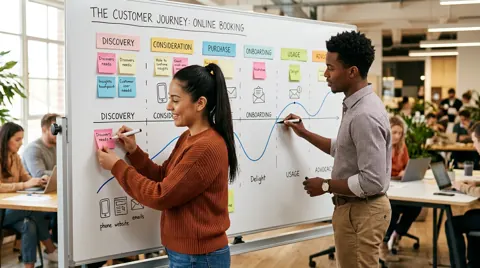
Visualize a person's end-to-end experience across steps, emotions, and touchpoints to find pain and opportunity.
Synthesize · Ideate
Classify features by how their presence or absence shifts user satisfaction.
Ideate
Run a structured, agenda-less discussion where participants vote on what to talk about.
Initiate · Ideate
State beliefs as testable predictions so you can learn quickly instead of debating opinions.
Immerse · Synthesize
Map how people think about a task and align your features against those mental models to find gaps.
Prototype
Design the small, single-purpose moments, toggles, feedback, that make an interface feel right.
Immerse · Ideate
Branch outward from a central topic to explore and organize related ideas.
Ideate · Prototype
Collect visual references to establish and align on a design's look and feel.
Synthesize · Implement
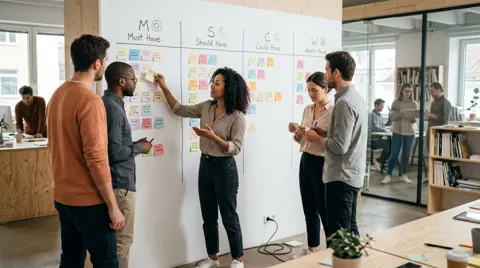
Sort requirements into Must, Should, Could, and Won't to agree on scope.
Prototype
Prototype transitions and animation to design and communicate motion precisely.
Implement
Test several element changes at once to learn which combinations drive the outcome.
Synthesize · Prototype
Design around the real-world objects users care about before designing actions and screens.
Synthesize · Ideate
Connect a desired outcome to the opportunities that drive it and the solutions that address them.
Prototype
Test interactions with hand-drawn screens before building anything digital.
Ideate
Have several people design independently in parallel, then compare, to widen the solution space.
Immerse · Ideate
Involve end users directly in design activities so the solution reflects their real needs.
Synthesize · Ideate
Weight your personas with a fixed budget, then score every feature by who it helps, so value rises to the top instead of being mandated.
Synthesize
Represent key user types as memorable archetypes to keep design decisions grounded in real needs.
Prototype · Implement
Rewrite content so people can read, understand, and act on it the first time.
Initiate · Ideate
Imagine the project has failed, then work backward to surface risks while you can still act.
Initiate · Synthesize
A crisp, shared articulation of the problem worth solving, before anyone jumps to solutions.
Prototype · Implement
Measure how hard your text is to read and whether it suits your audience's reading level.
Immerse
Find and schedule the right people so your research reflects the users you actually serve.
Synthesize
Identify the few high-traffic, high-importance tasks that must be effortless, and protect them.
Prototype · Implement
Run a live, moderated usability session with the participant and facilitator in different locations.
Synthesize · Ideate
Rank initiatives with a formula of reach, impact, confidence, and effort.
Initiate · Implement
Sequence outcomes and work over time to align the team on where things are heading and why.
Synthesize · Ideate
Narrate how a specific person accomplishes a goal so the team designs for realistic context.
Synthesize · Ideate
Extend a journey map with the backstage people, systems, and processes that deliver each frontstage moment.
Synthesize · Implement
Rate usability problems by impact so teams fix the most damaging issues first.
Synthesize · Prototype
Map the hierarchy and structure of a site or app's pages and sections.
Ideate · Prototype
Think with a pen: explore many ideas fast and cheap before committing to any.
Initiate
Plot stakeholders by influence and interest to decide who to engage and how.
Initiate · Immerse
Interview the people who own, fund, or are affected by the work to surface goals, constraints, and risks early.
Initiate
Chart who has interest and influence over the work so you engage the right people at the right time.
Prototype · Implement
Check a design against required standards, platform guidelines, and internal policies.
Ideate · Prototype
Tell the user's story frame by frame to keep design grounded in context and narrative.
Ideate · Prototype
Define the visual language, color, type, buttons, in a compact reference before full mockups.
Immerse · Implement
Ask a defined set of questions to many people to measure attitudes and self-reported behavior at scale.
Immerse · Synthesize
Break a goal into the concrete steps, sub-tasks, and decisions people perform to accomplish it.
Synthesize · Prototype
Diagram the single sequence of steps to complete one task, without user-specific branching.
Synthesize · Prototype
Design the categories and labels that organize content so people can find things.
Synthesize · Prototype
Test whether people can find things in your structure, stripped of visual design.
Implement
Collect every variant of each interface component to see the real scope of your UI.
Prototype · Implement
Have participants complete tasks on their own while a tool records what they do.
Implement
Measure usability metrics the same way over time to track whether the experience is improving.
Immerse · Prototype · Implement
Watch representative users attempt real tasks to find where the design helps or gets in their way.
Synthesize
Specify the steps of an interaction between a user and system, including alternate and error paths.
Ideate · Prototype
Diagram the paths a user takes through a product to reach a goal.
Synthesize
Describe how a specific user accomplishes a goal, giving design decisions a concrete context.
Synthesize · Implement
Capture a need from the user's perspective in a small, buildable increment.
Synthesize · Ideate
Arrange user stories along the flow of activity to see the whole and slice releases sensibly.
Initiate · Implement
Choose a coherent set of UX metrics tied to goals so you measure what actually matters.
Initiate · Ideate
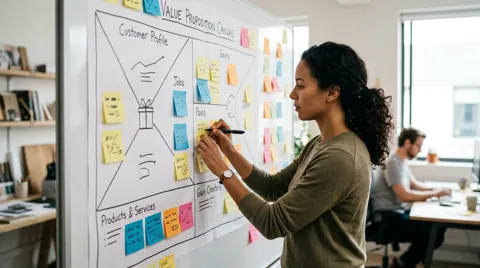
Map how a product's benefits fit the customer's jobs, pains, and gains.
Ideate · Prototype
Paint an aspirational picture of the future experience to align and inspire before building.
Prototype
Show alternative visual directions and ask people which they prefer and why.
Prototype · Implement
Define how the product sounds so content stays consistent and on-brand across contexts.
Ideate
Think together on a shared surface to explore ideas, flows, and structures in real time.
Prototype
Combine wireframes with flow arrows to show both screens and the transitions between them.
Ideate · Prototype
Lay out structure and content priority without visual design to focus on function.
Prototype
A human secretly performs the system's work so you can test an experience before building the tech.
Initiate · Immerse · Ideate
Design and run structured collaborative sessions that reliably produce outcomes.
Original method summaries with source attribution on each page. Illustrations are conceptual, not research evidence. Choose methods to fit your question, risk and context.