
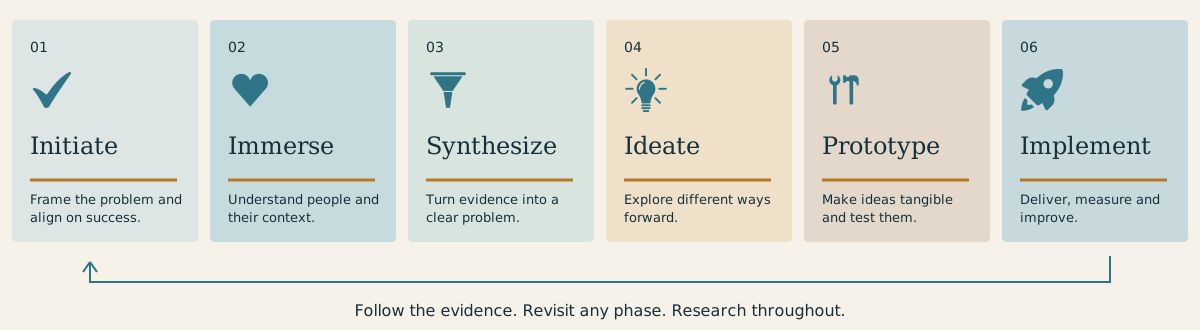
Design thinking is a human-centered, iterative approach to solving problems: understand the people affected, frame the right problem, explore ideas, and test and improve solutions. Evidence guides decisions, and teams revisit earlier phases as they learn. Scale the work to uncertainty and risk rather than following every step mechanically.
Initiate
Frame the problem and align on success. Browse initiate methods.
Immerse
Understand people and their context. Browse immerse methods.
Synthesize
Turn evidence into a clear problem. Browse synthesize methods.
Ideate
Explore different ways forward. Browse ideate methods.
Prototype
Make ideas tangible and test them. Browse prototype methods.
Implement
Deliver, measure and improve. Browse implement methods.
Evidence and limitations
Research can happen in every phase. Distinguish direct participant evidence from proxy feedback, expert review, simulation and inference. A prototype, persona or workshop output does not by itself establish usability. Trace findings to their sources and test important assumptions with the people affected.
Other process models
Immerse roughly maps to Discover or Empathize; Synthesize to Define; Ideate and Prototype to Develop; Implement to delivery and ongoing testing. Initiate makes framing and alignment explicit. These are useful crosswalks, not exact equivalences.
Icon credits
The phase icons match the methods library: Checkmark by komsiatun, Heart by Mol Media, Funnel by nasril, Light Bulb by Humantech, Tools by Noun Project, and Rocket by Adrien Coquet, from Noun Project. See the main page’s phase icon credits for original source links.
Need help choosing and applying a method?
Gumshoe helps teams connect research, collaborative workshops and service design to the decisions they need to make.