
Ethical AI should be something people can verify, not simply something companies promise.
We are becoming remarkably comfortable asking artificial intelligence to write, analyze, recommend, design, and increasingly act on our behalf. But a basic question remains unanswered: What gives us a reason to trust the result?
A polished answer is not proof. A company’s ethics statement is not an independent assessment. And a disclaimer, however prominently displayed, cannot make an unreliable system reliable.
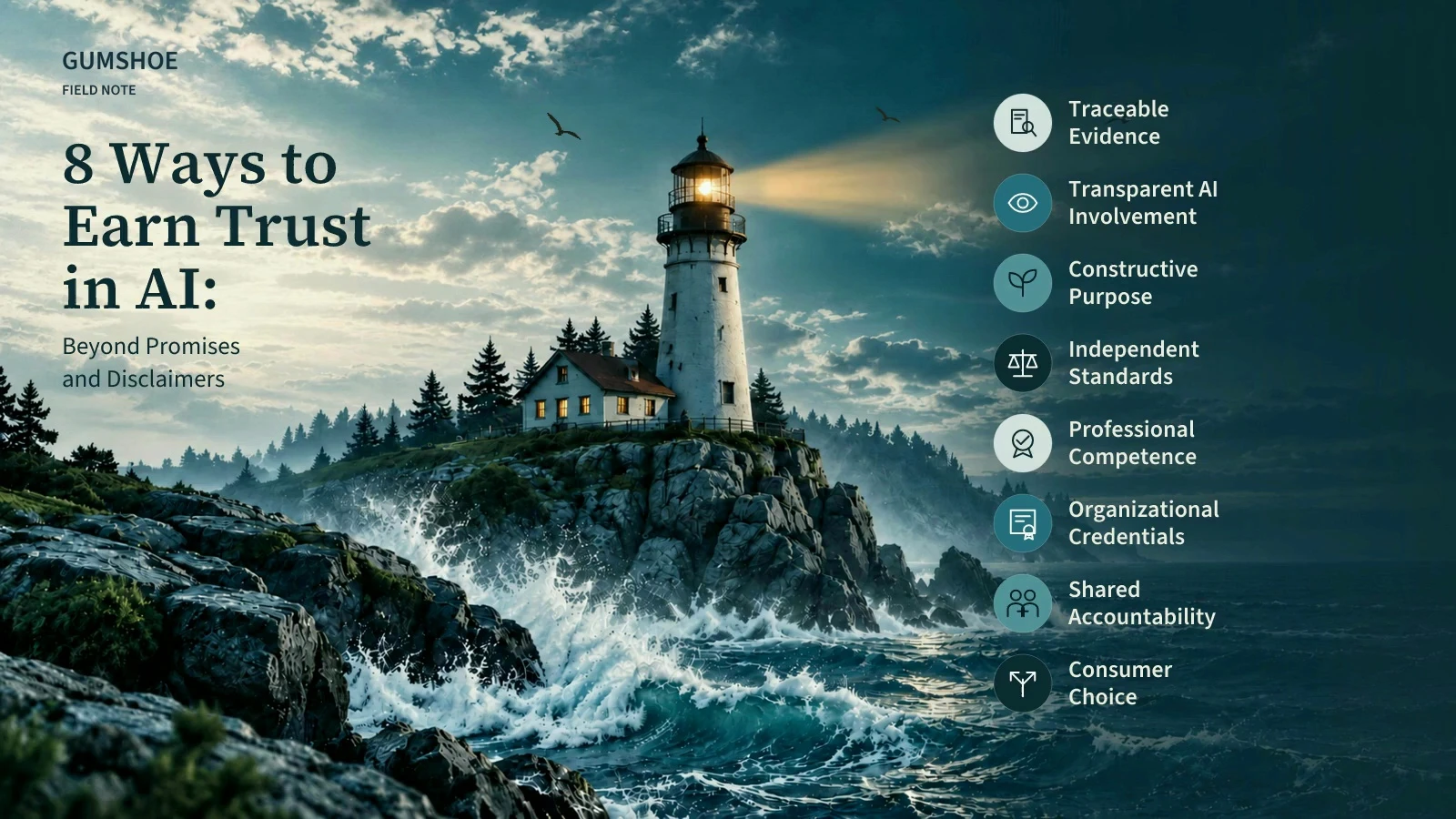
My view is that trustworthy AI requires more than a collection of good intentions. We need an ecosystem of transparent evidence, professional competence, independent standards, reasonable accountability, and meaningful choice. Many of these mechanisms already exist in other fields. We should learn from them rather than pretend AI is exempt from ordinary expectations of trust.
Here are eight foundations worth building on.
1. Show where the answer came from
When AI presents a factual answer, people should be able to examine the evidence behind it. That may include citations, the documents retrieved, their dates, and a clear distinction between quoted evidence and the system’s own inference.
There are practical limits to transparency. The information used to train AI may contain private or sensitive material, and AI systems cannot always identify the specific sources that influenced an answer. But that should not excuse fabricated citations or unsupported claims. AI should clearly distinguish between information it can verify and conclusions it generates.
Design implication: Make supporting evidence inspectable, indicate uncertainty, and make it easy to challenge or correct an answer.
2. Make AI involvement recognizable, without turning every interaction into a warning label
People should not be deliberately deceived into believing AI-generated content or an AI interaction is human-authored when that distinction matters.
But proportionality matters, too. Using AI to brainstorm headlines is not the same as letting AI determine a patient’s eligibility for a service. The disclosure should match the significance and risk of the use.
A useful approach is to document AI as part of a work product’s technology stack: what system or model was used, for what purpose, and what human review occurred. This gives clients meaningful provenance without burying them in repetitive disclaimers.
3. Evaluate whether AI is constructive, not merely efficient
Productivity gains alone do not establish that a system is beneficial. A faster process can still produce unfair decisions, misleading information, inaccessible experiences, or avoidable harm.
Teams should ask: Who benefits? Who bears the risk? What happens when the system is wrong? What human outcomes will tell us whether it is working?
For experience designers, this is familiar territory. We evaluate the entire service journey, not just the speed of one interface. AI deserves the same scrutiny.
4. Let independent standards bodies establish credible benchmarks
In many professions, trust is supported by recognized standards rather than self-declared excellence. AI needs comparable ways to demonstrate responsible practice.
Multiple organizations can develop credible standards for different contexts. A common baseline might address evidence quality, privacy, security, fairness, transparency, oversight, and incident response. Higher-risk uses should face more demanding assessments.
We already have foundations to build on. The NIST AI Risk Management Framework provides a voluntary approach to governing and managing AI risk. ISO/IEC 42001 establishes requirements for an AI management system. Neither is a universal stamp guaranteeing that every AI output is safe or correct.
Microsoft’s responsible AI transparency reporting offers another example of an organization describing its governance approach. Such reporting is useful, but it should complement, not replace, independent evaluation. An organization’s account of its own safeguards is not the same as third-party verification of how those safeguards perform in practice.
5. Certify competence, not just attendance
If I take my car to a mechanic, I value demonstrated qualifications. Training alone does not tell me whether someone can diagnose a problem, do quality work, or exercise good judgment.
The same should apply to professionals using AI. Meaningful credentials should test practical skill, domain knowledge, responsible use, quality assurance, and the ability to recognize when AI should not be trusted. Advanced credentials could require demonstrated work and periodic reassessment.
A certificate should represent a capability that has been evaluated, not simply a course that has been completed.
6. Give organizations a verifiable AI trust profile
Organizations already communicate their qualifications through audits, certifications, professional affiliations, and maturity assessments. They could do something similar for AI.
Imagine an AI Trust Profile showing which ethical commitments an organization has adopted, which standards it has been independently assessed against, what those assessments cover, when credentials expire, and how concerns can be reported.
This could be useful in procurement. A client handling sensitive information might require stronger evidence than a client purchasing low-risk creative services. Importantly, refusing one particular voluntary pledge should not automatically make an organization untrustworthy. Equivalent credible evidence should count, and smaller organizations should have realistic paths to demonstrating competence.
7. Define responsibility and reasonable protections before something goes wrong
AI-assisted work does not erase professional responsibility. The person delivering a service, the organization governing it, and the technology provider may each play different roles when an error causes harm.
Existing professional practice offers a useful starting point: clear standards of care, informed consent, documented decisions, appropriate insurance, and proportionate liability. Customers should understand material limitations, and responsible practitioners should be able to manage their risks.
But consent is not a blanket waiver of responsibility. Whether a disclaimer or contractual limitation is enforceable depends on applicable law and the circumstances. Good-faith use of AI should not become a pretext for avoiding accountability.
8. Protect consumer choice while allowing AI-first businesses to exist
Customers should generally be able to choose whether to use AI-assisted services. An organization should also be free to state clearly that its offering is AI-first or AI-only. In a competitive market, a customer who wants a different approach may choose another provider.
That principle has limits where choice is not realistic. In essential services or decisions affecting fundamental rights, meaningful review, appeal, accessibility, and other protections may be necessary. Transparency without recourse is a weak form of consumer protection.
The right role for government: a legal foundation, not a universal instruction manual
In the United States, constitutional protections and limits on government power should shape the public sector’s role in AI governance. Protecting civil liberties, due process, and legal and physical safety is different from government prescribing every professional workflow or technical design choice.
There is an important legal distinction: the Constitution primarily constrains government action. Protecting people from harms involving private AI providers may also require legislation, regulation, contract law, and existing civil remedies.
I favor a layered approach: government establishes and enforces necessary legal protections; independent bodies develop and assess professional standards; organizations demonstrate responsible practices; and consumers receive meaningful information and recourse.
Trust should be earned, demonstrated, and maintained
AI is changing faster than our institutions can comfortably adapt. That makes it tempting to settle for broad promises about responsibility, or to demand that every problem be solved by regulation. Neither is enough.
Trust is not a label a company gives itself. It is a claim supported by evidence.
We should be able to ask where an answer came from, how a system was evaluated, who is qualified to use it, what commitments an organization has made, and what happens when it fails. Those are not unreasonable burdens on innovation. They are the ordinary expectations we place on work that matters.
The question is no longer just whether AI can do the job. What would it take for you to trust the people and organizations using it?
References and further reading
- NIST AI Risk Management Framework
- ISO/IEC 42001: AI management systems
- Microsoft Responsible AI resources and transparency reporting
Written with AI assistance and approved by the author.
Commentary reflects an independent perspective and does not represent any current or former employer, client, or affiliated organization.